Showing posts with label tiki. Show all posts
Wednesday, January 12, 2011
The Drinking Dead
Zombie a la Puerto Rico
3/4 oz. Unsweetened pineapple juice
3/4 oz. Papaya nectar
Juice of a sizable lime
3/4 Barspoon powdered sugar
1/3 oz. Apricot brandy
1 oz. 86-proof Puerto Rican white rum
2 oz. 86-proof Puerto Rican gold rum
1 oz. 90-proof Jamaican heavy-bodied rum
Shake all with ice and pour unstrained into Zombie glass, adding cubed ice to nearly fill. Garnish with sprig of mint, small square of pineapple, and 2 cherries skewered on toothpick set so it bridges the rim of the glass. Carefully pour on a shallow float of 151 proof rum. Sprinkle with powdered sugar and stick in a pair of straws.
~ adapted from "The Esquire Drink Book" edited by Frederic A. Birmingham, 1956
Along with its partner-in-crime the Mai Tai, the Zombie is the drink that likely comes to mind when thinking of classic tiki recipes. And like the Mai Tai, it has an entertaining origin story (regardless of whether it's true or not, it's good that any drink's genesis be established in a way that lends itself to enthusiastic retelling. And all the better if that tale of creation is in dispute...it provides a drink with an aura of mystique and gives booze nerds something to research).
And just like the Mai Tai, conclusively determining the origin of the Zombie has been undertaken by Jeff "Beachbum" Berry. You can read the whole tale in his book Sippin' Safari, wherein he not only details his efforts but provides several versions of the drink (his subsequent book, Beachbum Berry Remixed supplies us with even more variations, so if you want to drink something called a Zombie, you've got a bunch to choose from).
However, if you are even a casual tiki drink enthusiast, you're probably already familiar with the lore, so let's get to drinkin'...
The Zombie a la Puerto Rico is one of three Zombie recipes ( I told you there was a bunch of 'em!) that turn up in The Esquire Drink Book, a great old bar guide from the 50's that's one of my favorites to flip through. I've always wanted to make this version, because it follows the basic Zombie blueprint, but also puts an interesting twist or two on it.
The combo of Puerto Rican and Jamaican rums appears in several Zombie versions, and pineapple juice shows up often as well, so we can file those under "usual suspects." However, the apricot brandy and papaya nectar are two ingredients I've never seen in a Zombie before (unless I'd forgotten about them as a result of having too many Zombies). Do they work? I'd say definitely.
One of the things I consider a hallmark of a well-designed and executed tiki drink is complex, layered flavors that remain distinct and in balance. The Zombie a la Puerto Rico succeeds there. You get solid rum flavor as a foundation, but it doesn't come off hot or bludgeon your tongue with sense memories of college drinks that were 90% cheap rum and 10% something else.* Rather, the rums emerge as subtle and elemental, simultaneously powerful and delicate. The mellowness of the brandy and the almost-not-there character of the papaya pulls the whole thing in a drier direction, and the hefty, tart squirt of lime jousts perfectly with the pineapple, leveling everything off with the requisite tropical vibe (although if you like your drinks a little less bitey, I'd suggest dialing the lime juice back slightly).
But like many drinks that get scrounged up from books with brown pages, it's tough to get ahold of ALL the ingredients used at the time the drink was created. I didn't have any Puerto Rican rum that was exactly 86 proof, so I settled for some similar 80-proof Virgin Island products. I also didn't have any robust Jamaican that came in at 90 proof, so I used a fifty-fifty blend of Smith & Cross and Appleton Reserve that did the job just fine as far as I'm concerned.** I also tend to prefer using simple syrup over granular sugar in most drinks, so I just subbed a small splash of Demerara. Fortunately, the gauge on my vat of Lemon Hart 151 still reads "full", and my stash of Marie Brizard Apry saved the day brandy-wise.***
Oh, and I used a tiki mug instead of a Zombie glass. Because I love those goddamned things.
*These were a beloved staple of my college years. A post on this is forthcoming.
**I really want to try working Coruba into this recipe somehow, but until Pennsylvania lowers the force field it has erected to keep it from entering the state, this experiment will have to wait.
***In a nifty bit of timing, Camper from Alcademics kindly pointed out the Washington Post site just posted a piece on apricot brandy. You should take that as some kind of sign.
Labels:
books/magazines,
fellow booze nerds,
rum,
tiki,
vintage,
zombies
Monday, September 13, 2010
Boozin' and Infusin'
For several reasons, I rarely drink coffee. However, that doesn't mean I dismiss it entirely, as I tend to examine even things I don't particularly like for cocktail potential. Coffee has been used in a number of drinks for some time now, but what I wanted to do was find a way to simply use the beans themselves rather than actually make coffee and work that into the mix.
This dovetailed nicely with my desire to get involved in infusing spirits, which is something I'd been meaning to experiment with for a while. The conventional wisdom is that clear booze like gin and vodka tend to be the most infusion-friendly, but since I often choose not to heed wisdom, I thought I'd take a stab at infusing some rum.
The first step was swinging by my local coffee joint and asking for some nice, middle-of the-road coffee beans. The knowledgeable gent who runs the place suggested a medium-roast Costa Rican variety, and since I trust his expertise implicitly (especially since I know squat about coffee), I was off to the races. The next stage was finding some rum...
Fortunately I have a few bottles handy, so this step wasn't too hard. I decided to try several styles of rum, and found that the one that yielded the tastiest results was Zaya Gran Reserva. Zaya is a nice dark rum that falls on the sweeter end of the spectrum flavor-wise, and it matches up with coffee wonderfully, it turns out. This is not to say that white rums and gold rums won't work (they do), just that it may take a bit of fiddling and trial-and-error to get combos that work well for you.
So what does infusing a spirit entail? Well, it's basically dumping hunks of something flavorful into liquor so that the liquor will absorb the flavor of whatever you put in it. You can make it pretty complicated if you want, but it's a fundamentally simple procedure. Here's my method:
1) Put coffee beans in rum.
2) Wait 24 hours and take them out.
Yep, that's all I did. I used a ratio of 1:4 (for example, a quarter-cup of beans to a cup of rum), and that imparted a nice, solid coffee flavor without overwhelming the rum. I swirled the beans around a couple times and strained everything when I was done, but that was about it. Nothing really brain-breaking.
Flavor aside, I was also curious about whether any caffeine would transfer to the rum. After a brief consultation with a science-type guy I know, the answer he provided was "Yes." (He elaborated on this to a degree, but it's enough to know that it happens). I can verify this is true, because after sampling several infusions, I got tuned up pretty good. Experiencing both a caffeine AND an alcohol buzz simultaneously is a distinctive feeling, and now I have a glimpse into why the whole "vodka-and-Red Bull" phenomenon took off. Still, I don't recommend basing a cocktail around the concept of stimulants and depressants struggling for control of your nervous system. I seem to remember hearing something about that being bad from my 8th-grade health class, and if you can't trust the girl's gym teacher on matters of body chemistry, where can you turn?
Nonetheless, I encourage everyone who finds this idea appealing to do it. It's easy, and playing with combinations of different rums and coffee is big fun. Just bear in mind that the type of beans, the amount, and the length of time you leave them to soak will affect the end result. I found out that leaving them soak longer than 24 hours, regardless of rum type, will ratchet up the bitterness, and after a 2- or 3 -day soak, your rum will really have an edge on it. But if you like that sort of thing, then sally forth.
And of course, the whole point of this exercise was to have a nifty drink ingredient. Again, some experimentation was required, and it turned out the biggest obstacle I faced was using it judiciously enough so that everything didn't end up tasting like Kahlua. After trying several concepts and tinkering extensively, I put together something I can live with:
Java Wind
1 oz. Coffee-infused Zaya Gran Reserva rum
.75 oz. Brugal Anejo rum
.75 oz. Appleton V/X rum
.5 oz. Mandarine Napoleon
.5 oz. Demerara simple syrup
2.5 oz. Unsweetened pineapple juice
2 dashes Angostura bitters
3 drops Fee's Whiskey Barrel Aged bitters
6 drops Vanilla extract
Shake all with ice and strain into highball glass filled with crushed ice. Garnish with orange peel and pineapple leaf.
Now I know that there are some gadget freaks and gearhead types out there expressing concern that most infusion methods involve an appalling lack of hardware and/or engineering. If you are one of those people, I direct you here, where you can indulge your perverse cravings for pressurized gases and precision-tooled metal.
Friday, September 3, 2010
Anatomy of the Drink: Mai Tai
"I went and sat on Hunter's lap for awhile, and he ordered a variety of drinks, and then he said, "Mai Tais!"
~ Anjelica Huston, "Gonzo: The Life of Hunter S. Thompson"
"A Mai Tai, made properly, is strong enough to put permanent fissures in a fat man's brain, yet delicate enough to make his girlfriend try to conjugate verbs with her thighs. The ingredients might come from the Caribbean. The South Pacific might have made it famous. But the Mai Tai comes from California and is so by-God American that any bartender who can't make it should be shot for treason."
~ Joe Bob Briggs, "The Great Mai Tai Hunt"
"They're lethal."
~ Richard Nixon
The Mai Tai is one of a very small category of drinks I call "bulletproof." That is, you can give a drink of this type to virtually anyone and they'll like it. It's not easy to find a drink that appeals to almost everybody, yet the Mai Tai pulls it off. Even people who hate rum admit that it's pretty darn good.
Universally beloved drinks usually have a history, and the Mai Tai is no exception. However, I will not be dealing with that here, since Mai Tai lore has been well-documented elsewhere. If you find yourself craving the details of how this remarkable concoction came about, I suggest you start by checking out Beachbum Berry Remixed by Jeff Berry and And a Bottle of Rum: A History of the New World in Ten Cocktails by Wayne Curtis. Both books devote entire sections to the Mai Tai and its significant place in the cocktail pantheon. If you want to go pick those up now and read the relevant parts, go ahead. I'll wait.
Back? Okay, great. What I will be doing is taking a peek at the drink itself. Specifically, the nuts & bolts of what makes this drink so great (and worth your time and trouble to make correctly). Now at this point, anyone who browses boozeblogs at least semi-regularly is thinking, "Jesus, another cocktail geek is writing about the freakin' Mai Tai??!!" Guilty as charged. My pixelated and pickled pen pals in the cocktail blogging community have already done an exemplary job in examining it from all angles, and the best I can hope to do here is humbly toss out one or two tidbits that may enhance the existing collective analysis of this classic drink.
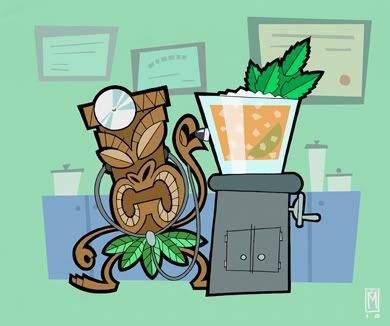
Plus, I made a drawing of a tiki doctor giving a Mai Tai a physical exam. That has to count for something at least.
First, a quick gander at what is generally considered the authentic, original recipe from 1944:
2 oz. Wray & nephew 17-year-old Jamaican rum
.5 oz. French Garnier Orgeat
.5 oz. Holland DeKuyper orange Curacao
.25 oz. Rock Candy Syrup
Juice from one fresh lime
Shake everything with ice and strain into a double old-fashioned glass full of crushed ice. Garnish with half the spent lime shell inside the drink and a sprig of fresh mint at the edge of the glass.
Looks fairly simple, right? There's just a few problems:
1) Wray & Nephew 17-year old rum hasn't existed for decades.
2) To the best of anyone's knowledge, Garnier orgeat can no longer be found either.
3) The current formulation of DeKuyper's orange Curacao is almost certainly not the same as it was back in '44.
4) What the hell is Rock Candy Syrup?
5) And while we're at it, what the hell is orgeat? And Curacao?
6) How much juice can I get from a lime?
If we want to make at least a somewhat legitimate attempt to approximate what this recipe tasted like, we have to make some concessions. Remember, the ability to compromise is a virtue, so let's keep the common good (making a tasty drink) in mind and soldier on.
Now here you may be thinking, "But wait...on vacation last Summer I had a Mai Tai at 'Benny's Beachfront Bazooka Bar' in Panama City, and it had pineapple juice and orange juice and red stuff and came in a hollowed-out cantaloupe with a live tree frog impaled on a sparkler as a garnish. This recipe leaves a bunch of stuff out!"
The short answer is no, it doesn't. For the sad tale of how the original Mai Tai was bastardized into oblivion almost from the moment of conception, consult the sources listed above. For now, back to the drink...
Like I mentioned above, concessions have to be made even if we're trying to re-create this drink as faithfully as possible. To that end, there are a number of modified recipes that do a good job of approximating the original, but since it's impossible to know exactly what it tasted like from top to bottom, we have to make some allowances. Lighten up- it's only a drink after all.
After extensive trial-and-error with more recipes than I can remember, this is the one I happen to like best:
1 oz. Appleton V/X rum
1 oz. St. James Royal Ambre rum
.5 oz. Marie Brizard orange Curacao
.5 oz. Orgeat
.75 oz. Fresh lime juice
Shake everything with ice and strain into a double old-fashioned glass full of crushed ice. Garnish with half the spent lime shell inside the drink and a sprig of fresh mint at the edge of the glass.
So let's break this sucker down...
RUM: The Mai Tai is a rum-based drink, and hardcore rum geeks did us a great service awhile back by suggesting that mixing equal parts aged Jamaican rum (the Appleton) and Martinique rum (the St. James) approximates the character and flavor of the long-gone 17-year old Wray & Nephew called for in the original. And for that we thank them. When you pair the right rums, the combination absolutely sings, and is the foundation of a worthwhile Mai Tai. In fact, the "One Jamaican, one Martinique" rule of thumb has proven so fun to follow, that it has compelled more than one Mai Tai enthusiast to tinker endlessly with 2-part rum combos in search of the "perfect" Mai Tai...which is really just the one you happen to like best. Follow their example and experiment on your own. There's a lot of rum out there, so don't be bashful.
ORANGE CURACAO: Orange Curacao is a liqueur usually made with bitter orange peel as the main flavor component, but formulas vary from brand to brand, some adding or substituting a variety of other ingredients and using different alcohols as a base. All you really need to know for making a good Mai Tai is to avoid the cheap stuff. How do you know what brands to steer clear of? A good place to start would be to check out the valiant efforts of this guy who has compiled more orange liqueur reviews than anyone I know of. I happen to prefer Marie Brizard for my Mai Tais, but as I said above, experiment until you find one you like!
(Oh, and in a pinch the blue stuff is fine, except that your Mai Tai will end up green.)
ORGEAT: Orgeat is a syrup flavored primarily with almonds and a small amount of orange flower water. Sometimes rose water is also added, but it's not crucial to the flavor. Orgeat is key in making a decent Mai Tai, and using a substandard one will sink an otherwise good drink. The general consensus is that making your own is ideal- It's nowhere near as difficult as it might sound, and I've found this recipe is simple and yields a wonderful-tasting syrup that is superior to any commercial product I've tried. However, if you don't feel like fiddling with all that, there's a person who can provide you with some that is the next best thing to homemade.
(Full disclosure: The labels for Trader Tiki syrups feature my dopey artwork, but don't let that influence your buying decision- The stuff on the inside of the bottle is top-notch.)
Also, people ask me all the time how to pronounce "orgeat", and since no two people I've ever asked say it the same way, I'm as stumped as they are. I've found that pronouncing it "almond syrup" usually gets the job done.
ROCK CANDY SYRUP: This is essentially simple syrup (sugar and water heated until the sugar dissolves). "Rock Candy Syrup" is the name Trader Vic's sells it under, but you can make your own simple syrup easily by combining sugar and water in varying ratios (1:1, 2:1, and so on). I use Demerara sugar because of the depth of flavor it adds, but since the Mai Tai recipe I like omits the .25 oz. simple syrup, I save it for other drinks. But if your Mai Tai needs a little sweetening, fire away!
LIME JUICE: It's been said a thousand times already, but bears repeating: Use fresh lime juice. That means buying fresh limes, cutting 'em open and squeezing out the juice by whatever means you prefer. And since limes can vary widely in size and juice content, I've found that .75 oz. is a nice amount regardless of how stingy or forthcoming your limes may be. Just remember- the little blast of citrus acidity and tartness the lime juice provides is another key component in a Mai Tai, so always use fresh-squeezed. Or the ghost of Vic Bergeron will angrily take up residence in your liquor cabinet and mock you viciously.
GLASS: The Mai Tai is served in a double old-fashioned glass. Why? Because Vic said so, that's why. Aside from that, a double-old-fashioned glass holds the liquid, a pile of crushed ice, a half a lime shell and a mint sprig perfectly. I admit to using a variety of tiki mugs for my Mai Tais from time to time, but that's no crime given their thematic harmony with the beverage in question. Remember: learn the rules before you break them.
ICE: Get hard, clean ice cubes and crush 'em. Put them in a hand-cranked crusher, wrap them in a towel and whack it with a rolling pin, throw them in the blender, use a Lewis bag and mallet, whatever...just pick a method that works for you and crush that ice. Then dump it in your glass where it will await the rich, amber embrace of your about-to-be-poured Mai Tai. Just make sure to leave a few cubes unmolested for shaking.
GARNISH: Hopefully you didn't immediately whisk one of your lime halves into the trash after juicing. If so, pull it out of the trash and place it into your drink. Just kidding. Take your clean, freshly-juiced half-shell and gently push it into the drink so it nestles regally amongst the sparkling ice and alluring liquid. Then get a healthy, robust sprig of mint and slap it a few times in the palm of your hand to release the minty essence. Slide it into the drink and admire your handiwork.
Lots of people like to use the Mai Tai as a blank canvas for their inner Bob Ross. This is fine, and given that the Mai Tai is a tiki drink, flowers, powdered sugar, orange peel sculptures and other ephemera aren't beyond the pale. I'd never deter you from using all the happy little trees you like, but I have an affinity for the minimalism inherent in a simple lime shell and mint sprig.
A quick note about straws- some people like 'em, some don't. Not using a straw gets the mint right up in your face and adds the aromatic component of the garnish. Conversely, using a straw keeps your moustache out of the drink. Your call.
Assuming you've followed at least some of the suggestions above and assembled your Mai Tai with care and diligence, you've got a bulletproof cocktail. Enjoy it with friends or just shovel down a few while watching Magnum P.I. reruns. It works either way.
And for those of you who need more Mai Tai mojo, here's a few other places online that have devoted considerable time & energy to examining this fine drink...
SLOSHED!
The Pegu Blog
The Pegu Blog strikes again!
Looka!
Kaiser Penguin
Chip & Andy's Universe
Cask Strength
Cincinnati Cocktails
Labels:
anatomy of the drink,
books/magazines,
rum,
tiki,
vintage
Wednesday, April 7, 2010
A Bibulous Bibliography: Beachbum Berry Remixed
A while ago I wrote about a book that has a permanent place next to all my shakers, stirrers, bottles and glasses: Vintage Spirits & Forgotten Cocktails. Occupying an adjacent piece of real estate are the various books authored by Jeff "Beachbum" Berry. (If my bookshelf was an actual neighborhood, these would be the guys who are always out the front lawn, drink in hand, starting impromptu block parties).
The books in question, Sippin' Safari, Grog Log and Intoxica! are the definitive bibles of tiki/faux-tropical drink-making and history, and any half-aware cocktailian owns 'em. As for the author himself, there's not much I can add that hasn't already been documented elsewhere. Suffice it to say that Berry's impact on the tiki drink landscape can't underestimated- if it weren't for him, we'd all be buying powdered Mai Tai mix and drinking the equivalent of rum Slurpees.
So yeah, the guy pretty much single-handedly saved classic tiki drinks from being lost forever. No small feat, which is why you should have at least one of his books behind your bar at all times. And if you had to limit yourself to only one, the book I'd recommend conveniently just came out last week: Beachbum Berry Remixed.
Don't worry- I'm not going to do a full-on book review here. This is because:
1) There are going to be a ton of better-written ones appearing in the coming weeks.
2) When I write big, long posts it really cuts into my drinking time.
So the here's the scoop: Beachbum Berry Remixed combines the info from Grog Log and Intoxica! and wraps it all up with a boatload of full-color photos and illustrations. You get recipes, you get history, you get anecdotes, and you get useful facts on ingredients, including brand recommendations and how to make some things at home (if you're so inclined).
More importantly, there's new stuff. BBR isn't a barely-disguised attempt to re-package existing material like some lame greatest hits collection. The Bum has provided a bunch of new recipes (both his own and newly-unearthed ones), and there's also fresh background material on people, places and potions sprinkled throughout.
I'd also be remiss if I didn't mention there's an entire section containing new original recipes by drink writers, cocktail experts, bartenders, and people who play with booze and then blab about it online (a.k.a. bloggers). If you're the kind of person who travels the boozeblog circuit, you'll notice some familiar names, as there are contributions by this guy, this guy, this guy, this guy (who, by the way, is attempting to make every single drink in the book), and yours truly (As with my appearance in Vintage Spirits and Forgotten Cocktails, I've yet again found myself among people far more knowledgeable and experienced than myself. Nonetheless, I'm extremely flattered).
Anyway, if you're still reading this, stop now and go buy a copy of Beachbum Berry Remixed from your favorite purveyor of mashed-up trees and ink. Then make yourself a drink from it. One of my favorites is...
Zombie (midcentury version)*
1 oz. fresh lime juice
1 oz. fresh lemon juice
1 oz. unsweetened pineapple juice
1 oz. passion fruit syrup
1 oz. light Puerto Rican rum
1 oz. gold Puerto Rican rum
1 oz. lemon Hart 151-proof Demerara rum
1 tsp. Demerara sugar syrup
1 dash Angostura bitters
Shake well with lots of crushed ice and pour into a tall glass.** Garnish with a mint sprig.
* people who like this incarnation of the Zombie (like me) take considerable guff from those who prefer the other versions. Whether this is due to its hazy provenance, less-intensive rum profile or inclusion of passion fruit syrup remains to be conclusively determined. Regardless, I'm sticking to my guns.
** Because I'm a colossal nerd and take this stuff way too seriously, I like to shake with a few large ice cubes and strain into a glass filled with crushed ice. Tomato, tomahto.
UPDATE: I forgot to mention that the Grogalizer has been updated and is fully operational! If you want to know what recipes from any of Jeff Berry's books you can make based on what currently resides on your liquor shelf, then the Grogalizer is what you need. Get over there and start mixing!
Labels:
bibulous bibliography,
books/magazines,
fellow booze nerds,
rum,
tiki,
vintage
Wednesday, February 10, 2010
Tartan on Your Tiki
Skye Tai
1.5 oz. Blended Scotch (Pig's Nose is great for this drink)
.75 oz. Amer Picon
.5 oz. Orgeat
.5 oz. Fresh lime juice
1/8 tsp. Absinthe
1 dash Fee's rhubarb bitters
Shake everything with ice and strain into double old-fashioned glass filled with crushed ice. Garnish with a lime slice and a cherry.
I've mentioned Thursday Drink Night before- It's the weekly online improvisational cocktail extravaganza where everyone is welcome to drop in, stick around as long as they like, and experiment with cocktail-making. I like to think of it as a jam session with booze instead of music. It's casual, friendly, and I guarantee it includes more references to Ting than any other chatroom you'll wander into. How's that for enticing?
A few weeks ago, the TDN theme was "Scotch", and I came up with the above recipe right around last call (sometimes the creative gears don't start turning until well into the night...TDN is funny like that). In any case, for reasons I'm still not entirely sure of, I was inspired to come up with a tropical-style drink. Scotch already has a reputation as being somewhat uncooperative in cocktails (with a few notable exceptions), so given my predilection to make difficult tasks even harder, I decided it would be a nifty challenge to see if I could get Scotch to behave itself in a tiki-ish cocktail.
I used the venerable Mai Tai as a loose template, retaining the lime juice and orgeat, but swapping in some new ingredients to take things in a different direction (toward the Hebrides, it seems). I'll be the first to admit it looks odd on paper (or screen), but it's gotten positive feedback from the intrepid souls who've tried it, so I'll consider it a keeper. Plus, it afforded me the opportunity to draw a tiki wearing a kilt and a Tam o ' Shanter, so really, the whole affair was out of my hands from the get-go.
Quick notes on some key ingredients:
1) I haven't empirically tested every blended Scotch out there, but I have found that Pig's Nose works wonderfully here. It's also great if you'd just prefer to dump it in a glass and enjoy it without fussing around with all the juice, syrup, ice and other miscellaneous distractions. As always, I encourage experimentation and investigation, and eagerly await your findings.
2) I haven't yet run across a commercially-made Amer Picon that I'm wild about, but the homemade stuff that my fellow boozeblogger SeanMike Whipkey of The Scofflaw's Den makes is fantastic, and it's what I use in this drink. His version is based on Jamie Boudreau's Amer Picon recipe, which just goes to show how incestuous the booze geek community really is.
If you want some, contact SeanMike directly. I hear he'll do just about anything in exchange for a case of Miller Lite.
One more thing- Since this post revolves around a quasi-tiki drink, I'd be remiss if I didn't mention that for the second year in a row, The Pegu Blog has transmogrified into The Tiki Blog for the entire month of February*.
* February is the shortest month of the year, but since Doug posts approximately every 17 minutes, he makes up for it.
Labels:
fellow booze nerds,
Thursday Drink Night,
tiki,
whisk(e)y
Wednesday, September 2, 2009
Save the Date...and Save the Whales!

If you haven't already seen a slew of other boozeblogs alerting us to the fact that tomorrow night (9/3) we celebrate the one-year anniversary of Thursday Drink Night, then here's the highlights:
~ TDN has been going on for a year, and we're celebrating!
~ There'll be a bunch of prizes awarded in a number of categories!
~ Jeff Berry and Martin Cate will stop by!
~ It's open to everyone, so don't be a wallflower!
~ Oh, and the theme is "tiki".
Speaking of tiki...
I've had this recipe kicking around for a while now. It came with a tiki mug I bought from the Queequeg Chapter of the Fraternal Order of Moai., which is an organization of fine, upstanding tiki freaks. I'd been meaning to make it for some time, and I finally rounded up most of the ingredients, so make it I did. Here's the recipe:
Queequeg's Harpoon
1 oz. Lemon Hart Demerara Rum (80 proof)
1 oz. Gosling's Black Seal rum
1 oz. Hurricane rum
.75 oz. lime juice
.75 oz. Queequeg's Blood*
.5 oz. simple syrup
.5 oz. club soda
Shake all (except club soda) w/ 8 oz. crushed ice. Pour into Queequeg MS Society mug. Add club soda. Garnish with cranberries and pineapple chunks on a bamboo spear. Repeat as necessary.
*Queequeg's Blood (cranberry syrup)
2 parts dried cranberries
1 part water
1 part cranberry juice (NOT from concentrate)
.5 part sugar
.5 part brown sugar
1 pinch whole cloves
1 three-inch cinnamon stick
Boil everything together at low heat, stirring constantly for 40 minutes. Let the mixture cool. Remove cinnamon stick. Blend mixture in blender until consistent. Strain multiple times through cheesecloth to remove particles. Bottle & enjoy!
Now the first problem I ran into was not having Hurricane rum, which is a small-batch, aged, slightly overproof gold rum that isn't exactly a commonplace item. Tiki guru extraordinaire Jeff Berry told me suitable substitutes would be something like a gold Puerto Rican (such as Bacardi 8) or amber Cruzan rum.
But because I like to ask people for advice and then not follow it, I subbed Old New Orleans Crystal rum and thought it worked fine. I also left out the club soda because it didn't really seem necessary.
The second problem I ran into is that even on paper, the "Queequeg's Blood" looks like a pain in the ass to make. I made it, and rest assured, it is. Plus, when I made it (using a "1 cup = 1 part" ratio), it yielded a paltry 3-4 oz. of liquid. So I came up with a recipe that's a lot less labor intensive, yields much more usable end product, and tastes the same in my opinion:
Queequeg's Blood (ver. 2.0)
1.5 cups dried cranberries
1.5 cups unsweetened cranberry juice
1 cup water
2 cups sugar
.5 cup brown sugar
15 whole cloves
2 three-inch cinnamon sticks
In a medium saucepan, bring everything to a boil, stirring until sugar is dissolved.. Lower heat, and simmer lightly for 30 minutes, stirring occasionally. Let cool, strain and bottle. Yields approx. 2.5 cups liquid.
So when all this tinkering was concluded, I ended up making this:
Queequeg's Harpoon (12" dance remix)
1 oz. Lemon Hart Demerara rum (80 proof)
1 oz. Gosling's Black Seal rum
1 oz. Old New Orleans Crystal rum
.75 oz. lime juice
.75 oz. Queequeg's Blood (ver. 2.0)
.5 oz. simple syrup
Shake everything with cracked ice and strain into double old-fashioned glass or tiki mug filled with crushed ice. Garnish with cranberries and pineapple chunks on a bamboo spear.
So instead of punching holes in an innocent sea creature, gather up your giggle water and make a few of these. If that still doesn't satisfy your bloodlust, there's always Deadliest Catch.
Monday, May 4, 2009
Cinco de Moai
According to the ads in the local free weekly paper, I’m supposed to be celebrating Cinco de Mayo somewhere that offers both Tequila and Mexican beer in colossal quantities for very reasonable prices. As appealing as I find stock photos of bikini-clad women with sombreros Photoshopped on them, I decided to ignore them and the ads they populate in favor of other diversions.
Diversion #1 was spending a chunk of Saturday afternoon watching the Kentucky Derby and some of the pre-race hype on TV. I don’t know squat about horses or why they like to run in circles, but it gave me an excuse to brush up on my Mint Julep technique.
Diversion #2 was using the Bourbon I had leftover from Diversion #1 to continue tinkering with a recipe I’ve been playing with for awhile. It’s a tiki-style concoction that features a conspicuous lack of rum*, but still (to me anyway) has the requisite “tiki taste.“
Bluegrass Blowgun
1.5 oz. Bourbon (I used Bulleit)
.75 oz. Agwa de Bolivia coca leaf liqueur
2 oz. unsweetened pineapple juice
.5 oz. simple syrup
.25 oz. cinnamon syrup
¼ tsp. Absinthe
2 dashes Angostura orange bitters
Shake with ice and strain into ice-filled double old-fashioned glass.** Garnish with orange wheel and any other tiki-themed paraphernalia that looks fun.
The secret weapon here is the Agwa, and I think it’s something that should be in every tiki drink enthusiast’s arsenal. It’s got a distinctive flavor- mellow, herbal, somewhat sweet, and with a borderline medicinal snap. It’s pleasing on it’s own, but it mixes so well it’s too much fun to not experiment with. Mr. Bali Hai over at Eye of the Goof apparently thought so too.
So even though I eschewed the fiesta crowd this year, I still think I should get some credit. Tiki drinks are technically south-of-the-border, right?
* I love rum…but I seem to have become enamored of rum-less tiki drinks lately.
** For bonus points, double the recipe and dump it into a Moai-shaped mug!
Thursday, September 25, 2008
Luau Grog/Ice Cone Capers

Luau Grog
3/4 oz. fresh lime juice
3/4 oz. grapefruit juice
3/4 oz. soda water
1 oz. honey mix*
1 oz. gold Puerto Rican rum
1 oz. dark Jamaican rum
1 oz. Demerara rum
Dash of Angostura bitters
2 oz. crushed ice
Put everything into a blender saving ice for last. Blend at high speed for no more than 5 seconds. Pour into a double old-fashioned glass. Serve with ice cone.
*To make honey mix, heat one part honey and one part water until honey is thoroughly dissolved. Once cooled & bottled, it will last approx. one week in the fridge.
- From "Sippin' Safari" by Jeff Berry
I’m going to get this out of the way right up front. I made this drink because of the ice cone.
True, the recipe initially caught my eye because I’m a fan of a couple other drinks hailing from the Luau menu (those being the Jet Pilot and their version of the Scorpion). And even though the Luau Grog is an ever-so-slight reworking of a Navy Grog, I still wanted to give it a go and see what it was all about.
But really folks, it’s all about the ice cone.
After a cursory spin around some other boozeblogs, I noticed that Paul had previously tackled this very same drink, Blair had done a run-through on the Navy Grog, and Tiare had done some experimenting with various ice molds. But it seems nowhere near as many people had fiddled around with ice cones as I’d assumed. Were they that hard to make?
I’ll admit *I* was intimidated. But after a little reflection, I thought, “Hey, I hollowed out a pineapple without causing arterial spray, so how hard can it be to pack some shaved ice into a beer glass??”
What follows is my saga of ice cone creation. It’s a tale filled with joy, wonder, disappointment and self-discovery. Join me, won’t you?
I started by consulting the instructions provided in both Jeff Berry’s Sippin’ Safari and the profile piece on Berry in the May/June ‘07 issue of Imbibe (both include the recipe for the Luau Grog, and I wanted to cross-reference them for any variances).
The instructions in both sources were identical:
“For the ice cone, pack a pilsner glass with finely shaved ice, run a chopstick through the middle to make a hole for the straw, and freeze the cone overnight.”
Simple enough. I grabbed a pilsner glass, made some shaved ice, filled up the glass and made the chopstick-hole. Then into the freezer.
Here’s where things got interesting.
After a few hours in the freezer (I didn’t see the need to make it an overnight affair- my freezer is pretty robust and I figured 4 hours would be plenty of time for the cone to set up nicely.), I took out my ice-filled glasses (I made two cones), and got ready to whip up some authentic Luau Grogs.
But there was a small matter of getting the cone out of the glass. Turns out those suckers were locked into their glasses like they’d been welded there. I tried to gently rotate one of the cones to break it’s grip…to no avail. My next idea was to gingerly slip a knife between the cone and the glass and slowly work it around. I immediately broke the glass with this method. Good thing I made two cones.
With the second one, I put it under the faucet and slowly ran warm water over the outside of the glass. After a few seconds, things warmed up to the point where the cone slid free of the glass. But it came out in three separate segments that I had to thread back together with the straw…like stringing a big icy necklace. But I made the drink, put in my gimpy cone and basked in my pseudo-success.
The very next day, I had an email exchange with several other boozebloggers discussing the differences between the Navy Grog and the Luau Grog. This prompted me to look up the Navy Grog recipe in Jeff Berry’s Grog Log where I noticed something important.
Following the Navy Grog recipe, there are instructions for making the ice cone. Here they are:
“Pack ten-ounce Pilsner glass with finely shaved ice. Run a hole through center with a chopstick to make a passage for straw. Gently remove cone from glass and freeze overnight.”
It’s the first part of the last sentence that makes all the difference. REMOVE CONE FROM GLASS and freeze overnight. This step is crucial, and it’s missing from the other instructions.
Armed with my newfound knowledge I set about to make some more ice cones. But a new challenge surfaced: I remembered I had 2 different styles of pilsner glass.
I had already used the straight-sided, stemmed one (glass “A”) earlier. The other one (glass “B”) held the same amount and would produce a cone of equal height, but it would obviously differ in shape. Would it matter? Only one way to tell- I made some cones using each glass.
In a nutshell, I got nice, solid, serviceable cones from each one. Personally, I prefer the ones made with the flare-sided glass, as its flat, wider bottom results in the top of the cone having a bit more heft. It’s mainly an aesthetic concern, but the thinner, pointy top of the other cone is more likely to break off when inserting the straw or while drinking.
And it’s at this point that anyone besides the 7 other booze nerds who make up my entire readership exclaim, “Jesus Christ, I can’t believe this guy is obsessively documenting the minute differences between tiki drink ice cone shapes !!”
Guilty as charged. And it only gets worse:
In the interest of the public good, I took it upon myself to offer a step-by-step ice cone-making process that worked pretty well for me. Hopefully it’ll work for you too.
1) Make some shaved ice by whatever method you prefer. (I don’t have a fancy ice-shaving gadget, so I just pulverize the daylights out of some small ice cubes in a blender until I get a snow-like consistency.
2) Pack your ice firmly into a 10-ounce pilsner glass all the way to the rim. This is the time to make sure you’re using only the finest ice bits. Allowing bigger hunks of ice into your cone will create points where it can fracture easily. I’m sure there’s technical term for this, but I’m an artist, not a Materials Science guy. I draw pictures instead:
3) In the center of the ice, push a chopstick the whole length of the glass to make your straw hole.
4) Leaving your chopstick in place, gently push down on the ice to re-pack any of it that may have gotten dislodged when making the hole.
5) Gently pull the cone from the glass (it should rotate freely and easily slide out…you can probably use the chopstick as a handle)
6) Cradling the cone gently, stand it upright in your freezer (I’d advise placing your cone on something with a smooth surface like plastic or wax paper so you can easily remove it later. (Don’t use something like a paper towel or a cloth). If you haven’t done it yet, remove the chopstick.
7) Optional Step: After the cone has been in the freezer long enough to re-harden, use a small spray bottle (Those vermouth misters and salad-oil spritzers work well) to give it a few spritzes of cold water. This will put a bit of a hard shell on the outside of the cone and help it hold together.
8) When the cone is fully frozen (a couple hours should do it, depending on your freezer), pull it out and insert the straw. You may have to gently open up the hole on one end (or both) if any of the ice shifted during all this nonsense.
9) Put it in your drink and sip away!
Speaking of the drink…
It’s pretty good. It definitely “tastes tiki”, but after having a few I couldn’t help but think it needed just a touch of something. The flavors all worked well together, but the total package seemed just a little flat & thin-tasting to me.
My remedy was to add a ¼ oz of falernum to pep it up and add a little spicy roundness. I like it much better this way.
So now that I’ve made the ice cone-crafting process sound really enticing, who’s up for making some? The first person to send me photographic evidence of their labors will, ummm…win a prize. Or maybe just my admiration. Yeah, that’s probably more likely than a prize.
UPDATE: I regretfully overlooked Mr. Bali Hai's fine efforts. See the juicy photos of his Navy Grog complete with ice cone here.
Wednesday, June 18, 2008
Fruit Cup
I’m embarrassed it’s taken me this long to make a drinking vessel out of a pineapple.
It really should have happened long before now. I’ve been fiddling with tiki-style drinks for well over a year, and I regularly buy whole pineapples, so it’s not like I don’t have them lying around. I’ve also attended at least a dozen Jimmy Buffett concerts, where unorthodox beverage containers abound (lawn flamingos, beer mugs made of a single piece of ice, etc.), so I really should have gotten on the stick by now.
After noticing one of the recipes in Jeff Berry’s Sippin’ Safari could be served in a pineapple, I decided to finally take the plunge. The first step was determining if there was a tried-and-true technique for transforming a large piece of fruit into a fun and functional drink container.
Turns out there isn’t one. Or more accurately, I couldn’t find one. The first thing I did was to contact some of the big brains in the booze nerd community and see what they do. I was surprised to find that most of the people I spoke to hadn’t yet attempted it, and the responses from those who had essentially boiled down to “Cut the top off, and scoop out the insides.”
I also did a little poking around on the web, but that was slim pickings too. There’s a promising-looking gadget designed specifically for taking the guts out of a pineapple, but the reviews were mixed. It appeared that I was headed for trial-and-error territory.
Now I’m the kind of person who doesn’t like to make things more complicated than they need to be, so I stuck close to the “cut off the top and scoop out the insides” method . I’ve made many jack-o-lanterns over the years, so my reasoning was that this would probably be pretty much the same, albeit on a smaller scale and with contents you’d actually want to eat.
I discovered that things shook out to be basically a three-step process:

1) Slice off the top. I cut horizontally about 1.5 to 2 inches below the leaves. If you want a wider, shorter cup, just make your cut farther down. I used my trusty Chinese vegetable knife, but feel free to use the cutting tool of your choice (machete, katana, chainsaw, etc.)

2) Outline a cavity. Run a small knife (I found a grapefruit knife works well) in a circular path near the outside of the pineapple. I recommend you don’t make this cut right up against the rind. Leave at least a half-inch of “meat.”- It’ll add strength to the cup once it’s hollowed out.
Also, this is the step when you’ll discover pineapples are surprisingly soft. Despite their rough exterior, they’re very easy to puncture. I immediately put a hole in mine even though I was trying to be as gentle and deliberate as I could.

3) Shovel out the insides. I used a stainless steel salad spoon, but any rigid, scoop-like implement without sharp edges or corners will probably do the trick. The core in the center will give you the most resistance, but you can use your small knife from step 2 to carefully carve out any stubborn bits.
Like step 2, there’s a bit of guesswork involved here. Just make sure you don’t scoop too deep or too close to the sides, otherwise you‘ll be creating an organic dribble glass.
Optional step: If you want to keep the top to use as a lid, just cut a small notch in the edge for a straw and replace it. You can fasten it to the bottom with a toothpick or cocktail umbrella.
As for the drink itself, I went with the Pina Paradise, from the aforementioned Sippin’ Safari.
Pina Paradise
½ oz. Fresh lime juice
½ oz. Grapefruit juice
½ oz. Orange juice
1/4 oz. Sugar syrup
¾ oz. Gold Puerto Rican rum (I substituted Cruzan)
¾ oz. Martinique rum (I used St. James Royal Ambre)
2 one-inch-square chucks of fresh pineapple
Dash Angostura bitters
6 drops (1/8 teaspoon) almond extract
Place in a blender, without ice, and blend at high speed until pineapple is liquefied. Pour into a cocktail shaker half-filled with ice cubes. Shake well, then pour into a hollowed-out pineapple or tiki mug.
It’s not bad. The rums come through pretty well (especially the Martinique) despite the number of other ingredients. The grapefruit, orange, pineapple and lime do well as a fruit base, and the almond extract is a nice touch- Although I may have to make this again and see what happens if I substitute orgeat.
Overall, it’s a tasty but not particularly remarkable drink. I found it a bit flat, but the Bamboo Babe loved it, so I’ll keep it in the rotation. But in the future, when I’m making another pineapple cup, I’ll likely opt to fill it with a Painkiller or something with a bit more oomph.
To wrap up, here’s a breakdown of my pros & cons for drinking out of a pineapple:
Cons:
Expense. Where I live, whole pineapples run between 4-5 bucks apiece. That can easily be a prohibitive cost depending on how many people you’re serving.
Labor. The time you spend making the cup detracts from time you can be drinking.
Flavor Factor. Whatever drink you put in the cup will be flavored with pineapple to some degree.
Weight. Even a hollowed-out pineapple can get a little heavy and unwieldy after a while.
Pros:
No-Slip Grip. The rind of a pineapple is a natural high-friction surface. If you drop it, it’s not the pineapple’s fault- you probably should have stopped two drinks ago.
Environmentally Friendly. Pineapples are biodegradeable, so when you’re done, compost it, chuck it in the woods, or simply drop it through the sunroof of your snooty neighbor’s Mercedes.
Edible. You can eat what you’ve hollowed out.
Style Factor. I mean, you’re drinking out of a pineapple…how cool is that?
So give it a shot- It’s not as tough as it might look, and it’s a heck of a lot of fun. And as always, tips, advice, cautionary tales, etc., are welcome.
Tuesday, May 6, 2008
For Medicinal Purposes Only
Jet Pilot
½ oz. Fresh lime juice
½ oz. Grapefruit juice
½ oz. Cinnamon-infused sugar syrup
½ oz. Falernum (Fee Bros.)
1 oz. Dark Jamaican rum (I used Myer’s)
¾ oz. Gold Puerto Rican rum (I subbed Cruzan)
¾ oz 151-proof Lemon Hart Demerera rum
Dash Angostura bitters
6 drops (1/8 teaspoon) Pernod
4 ounces crushed ice
Put everything in a blender, saving crushed ice for last. Blend at high speed for no more than 5 seconds. Pour into an old-fashioned glass.
Having spent a considerable chunk of April out of commission with pneumonia, I regrettably missed out on some drinking & posting I’d been meaning to do…including taking part in last month’s Mixology Monday. However, one advantage to this particular malady is that you always feel like you’ve had a couple of stiff drinks. It’s not the kind of buzz you can really enjoy though, because you’re constantly coughing and feeling like utter crap. But it does do wonders for your alcohol budget.
So right around the time my recuperation seemed imminent, a nice thing happened- I managed to acquire some Lemon Hart Demerara 151 rum (I’ll avoid the specific details as to how I finally got ahold of it because I don’t want the PLCB commandos parachuting into my backyard like that school scene from Red Dawn).
I also realized a batch of cinnamon-infused simple syrup in my fridge was nearing it’s expiration date, so the only reasonable course of action was to whip up a Jet Pilot. Plus, the vitamin C in the lime & grapefruit juice would certainly help with keeping me hale & hearty.
Did I mention I got to play with my ice crusher and mortar and pestle?
Anyway, The Jet Pilot appears in Jeff Berry’s excellent Sippin’ Safari, and it’s a keeper as far as I’m concerned. The conventional wisdom among tiki drink enthusiasts is that although many recipes feature a large number of ingredients (which presumably ratchets up the probability you‘ll screw something up), the end results can be strikingly balanced. The Jet Pilot is definitely one of those recipes. Rick and Robert thought so too.
As I mentioned, the balance of flavors is great. The cinnamon is front and center but doesn’t dominate. The rums blend beautifully, with the smoky burn of the 151 filtering through. The juices and falernum perk things up, and with only 6 drops (believe me, I measured this exactly) my old nemesis Pernod seemed in perfect proportion. This drink is now firmly entrenched on my list of “go-to” tropicals.
So will having a few Jet Pilots help you shake a stubborn illness? As the saying goes, “individual results may vary”. But while you’re behind the bar, make a few impassioned pleas to the tiki spirits- It could speed your recovery.
Monday, November 12, 2007
Mixology Monday: Gin

Del Coronado
1/2 oz. unsweetened pineapple juice
1/2 oz. passion fruit syrup
2 1/2 oz. orange juice
3/4 oz. fresh lemon juice
1/4 oz. fresh lime juice
1/2 oz. papaya nectar
1 oz. gin
1 oz. dark Jamaican rum
Shake well with ice cubes and pour into tall glass.
When I saw that this month’s MxMo theme was gin, I almost collapsed under the combined weight of options and excitement. Gin is my favorite spirit, and I didn’t even know where to begin. There is a phenomenon known as “choice overload” and I was clearly experiencing it.
But help was on the way. By pure happenstance, this past weekend I had the good fortune to play bartender to three women who, in addition to being a hell of a lot of fun, also enjoy a good drink. And like myself, these gals appreciate gin.
Slowly, ideas began to coalesce. I needed a MxMo entry…and also had the opportunity to serve several drinks (many including gin) to fellow enthusiasts…surely something concrete would materialize and form the nucleus of my entry. Best not to overthink or try to engineer it- I was going to let the drinks appear and see where things went. I don’t know if it could properly be called Zen, but it was in the ballpark.
My approach was to simply offer up a fairly wide-ranging menu of drinks and see what the proceedings yielded. The plan was no-plan, allowing the evening to set it’s own agenda. Knowing my crowd was partial to gin, it was a safe bet at least one gin-based recipe would be selected and perhaps become the basis for my post...but the main question was: Would things develop into a bare-knuckle gin drink showdown with recipes, brands, and styles subjected to rigorous scrutiny? Or would we casually meander through the offerings, perhaps ending up with nothing more than a pleasant ramble through a pile of drinks?
As it turns out, it was a little bit of both. The drinks chosen fell into two rough groups: tiki and gin-based. On the tiki side, Mai Tais and Zombies showed up. On the gin side, Pimm’s cups and Corpse Reviver #2’s made the cut.
All were enjoyed to varying degrees, and during the aftermath, I thought, “Well, since the drinks everyone seemed to go for either involved gin or were tiki-style, why don’t I look for a recipe that somehow combines both?”
Turning to my dependable Beachbum Berry tomes Grog Log and Intoxica! (Shamefully, I haven’t yet picked up Sippin’ Safari…feel free to heap abuse on me at your leisure), I eventually settled upon the Del Coronado (Aside from containing gin, I think the other reason I chose it was the challenge of finding papaya nectar...thrill of the hunt and all that).
Anyway, the Del Coronado is fruity. 6 of the 8 ingredients are fruit-based, and it really shows in the overall taste. The orange jumps out front, forming the main flavor, with the passion fruit close behind. The pineapple, lemon, and lime are less noticeable, meshing together into an somewhat indistinct fruit blend, with the papaya doing a bit of drive-by tartness. Lastly, the rum reveals itself on the finish, giving a quick wave to remind you that there was actually some grown-up stuff amidst the juice…kind of like finding a tarantula lurking around in your fruit basket.
But what about the gin? In this drink the gin plays a supporting but crucial role. You don’t notice it’s flavor so much as it’s feel. This is a drink that is thick with flavors, and rather than compete with them, the gin snakes it’s way around the edges, sharpening things up and keeping it the other ingredients from bogging each other down.
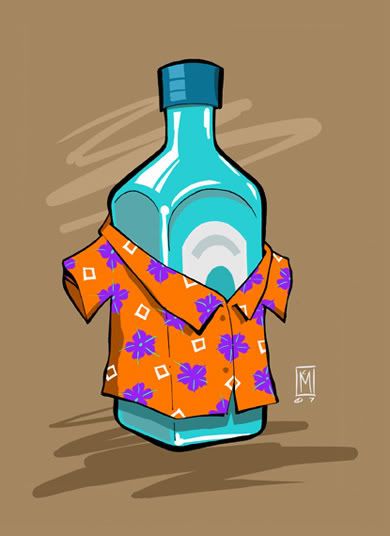
Maybe it’d be easier (or at least more fun) to say it this way: If the Del Coronado was a piece of clothing, it’d be a Hawaiian shirt with a great floral print (the juices), real coconut-shell buttons (the rum) and silver thread (the gin) stitching it all together.
Sound weird? Have a couple Del Coronados and maybe it’ll make sense. Call it “gin Zen.”
If a metaphor falls in the forest…
Monday, September 17, 2007
Mixology Monday: Fizz

Colonel Beach's Plantation Punch
1 oz. fresh lime juice
2 oz. unsweetened pineapple juice
1/2 oz. falernum
2 oz. ginger beer
2 dashes Angostura bitters
1/8 teaspoon Pernod
2 oz. dark Jamaican rum
1 oz. gold Puerto Rican rum
1/2 oz. Barbados rum
Shake with one cup crushed ice. Pour into tall glass with 3 or 4 ice cubes. Garnish with pineapple chunk and sprig of mint.
Baby Bamboo wasn’t the only thing to arrive last month. I also received a second bundle of joy- the bottle of falernum I finally got around to ordering. Unlike those industrious souls out there making their own falernum from scratch (My hat‘s off to you, you magnificent, fearless bottle-jockeys), I relied on the Fee Bros. this time around.
The arrival of the falernum sent me straight in one direction…right toward the Beachbum Berry books. I also figured I could find a recipe that would satisfy the “fizz” requirement for this month’s MxMo, and after some vigorous page-flipping I found it: Colonel Beach’s Plantation Punch, courtesy of Don the Beachcomber.
CBPP contains not only the falernum I’d been dying to try, but also ginger beer, which brings the fizz. Most importantly, It‘s a tiki drink, and I’d been meaning to put one of those through it’s paces since I started this whole enterprise.
After getting everything into (and out of) the shaker, the drink settled into the glass with a translucent, dusky amber color, topped by a frothy head that remains well after the pour. The rums & juices combine in an aroma that is unmistakably tiki, but it won’t knock you over with a boozy updraft…you have to move in and chase it.
After several sips I was pleased to find that the various flavors stand up well against each other. Many times I’ve had tiki-style drinks where the ingredients end up as an indistinct stew of citrus, rums, and sweeteners, often in lopsided proportions. By contrast, CBPP is a very evenly-flavored (some would perhaps say flat) tasting concoction.
Despite the evenness, the pineapple and Pernod still seem to pop a bit. They really complement the dryness of the rums, and the Pernod in particular is noticeable despite how little the recipe calls for. The ginger beer however, is almost nonexistent- the flavor isn’t evident, but rather the warm tingle of the ginger hangs in the background, assuming more of a texture than a taste (Although I’m guessing this can vary depending on the brand used).
Overall, I liked it. It’s not terribly distinctive, but it is pleasant, and a great example of a tiki-style drink. As I finished it, I couldn’t help notice its resemblance to another of Don the Beachcomber’s drinks: the Zombie. There are several similar ingredients (including 3 rums), and even the garnish is basically the same. The falernum taking the place of the passion fruit syrup is a departure, but the formula remains essentially intact.
Now I’m not bashing the Beachcomber by implying he merely dusted off an established recipe and made a few tweaks…but how’s this for an analogy? Ever met two siblings where the older one is brash and extroverted, and the younger one is quiet and charms all the older relatives with his mature reserve and politeness? The Zombie is the former and CBPP is the latter.
They’re both good kids. Spend time with each of ’em.
Friday, May 4, 2007
Pearl of Wisdom

Pearl of Wisdom
1 oz. dry white sake
1 oz. cherry brandy
1 oz. gin
2 oz. sweet and sour mix
Approx. half a lime's worth of juice (just enough to add tartness & a little pulp)
Splash of club soda
Place a Maraschino cherry or pearl onion (the pearl) in the bottom of a tall pilsner glass and cover with a couple inches of crushed ice.
Shake all ingredients (except club soda) with ice and strain into the prepared glass. Add club soda.
Garnish with a lime wheel and a pair of chop sticks. Place a fortune cookie on the rim of the glass.
Once served, the idea is to retrieve the "pearl" with the chop sticks then learn your fortune from the cookie.
This one comes direct from tiki enthusiast and carver extraordinaire Finkdaddy. In addition to creating incredible carvings & sculptures, Finkdaddy is a fan of adult beverages, and he recently submitted his original recipe, 'The Pearl of Wisdom."
This drink is outstanding.
Finkdaddy himself describes it as a variant of the Singapore Sling, and says it has been a big hit with friends and family. After trying it, I can easily see why.
The Pearl of Wisdom is a great example of a tiki-style drink, striking a wonderful balance between tart and sweet. The cherry and lime match up well, and combine to form the main flavors. There is a great citrus taste throughout, and the whole thing is unbelieveably refreshing.
The secret weapon here is the sake. It pulls the other ingredients together and puts a soft, dry tone on everything. As for brands, Finkdaddy recommends Momokawa Diamond, but not being able to find it locally, I substituted their Ruby and it was fantastic nonetheless.
Also, I'm generally not a fan of bottled mixes, but the sweet and sour works very well here. Just make sure you get some fresh stuff- this isn't the time to use up the remains of that derelict bottle that's been in the back of the fridge since last Summer.
Overall, if I had to choose between this and the Singapore Sling, I'm certain I'd take this one almost every time. The Pearl of Wisdom is drier and crisper, whereas the Sling is sweeter and fruitier. They're both great drinks, but I found the subtleties of the Pearl of Wisdom more appealing.
If you've been looking for incentive to buy a bottle of sake or cherry brandy, this is it. I can't recommend it highly enough.
And if you have a few minutes, check out Finkdaddy's excellent work at his site, The Leeward Lounge. You can also see additional pieces in this thread over at the Tiki Central forums.
Subscribe to:
Posts (Atom)