Wednesday, January 12, 2011

The Drinking Dead

Photobucket


Zombie a la Puerto Rico

3/4 oz. Unsweetened pineapple juice
3/4 oz. Papaya nectar
Juice of a sizable lime
3/4 Barspoon powdered sugar
1/3 oz. Apricot brandy
1 oz. 86-proof Puerto Rican white rum
2 oz. 86-proof Puerto Rican gold rum
1 oz. 90-proof Jamaican heavy-bodied rum

Shake all with ice and pour unstrained into Zombie glass, adding cubed ice to nearly fill. Garnish with sprig of mint, small square of pineapple, and 2 cherries skewered on toothpick set so it bridges the rim of the glass. Carefully pour on a shallow float of 151 proof rum. Sprinkle with powdered sugar and stick in a pair of straws.

~ adapted from "The Esquire Drink Book" edited by Frederic A. Birmingham, 1956


Along with its partner-in-crime the Mai Tai, the Zombie is the drink that likely comes to mind when thinking of classic tiki recipes. And like the Mai Tai, it has an entertaining origin story (regardless of whether it's true or not, it's good that any drink's genesis be established in a way that lends itself to enthusiastic retelling. And all the better if that tale of creation is in dispute...it provides a drink with an aura of mystique and gives booze nerds something to research).

And just like the Mai Tai, conclusively determining the origin of the Zombie has been undertaken by Jeff "Beachbum" Berry. You can read the whole tale in his book Sippin' Safari, wherein he not only details his efforts but provides several versions of the drink (his subsequent book, Beachbum Berry Remixed supplies us with even more variations, so if you want to drink something called a Zombie, you've got a bunch to choose from).

However, if you are even a casual tiki drink enthusiast, you're probably already familiar with the lore, so let's get to drinkin'...

The Zombie a la Puerto Rico is one of three Zombie recipes ( I told you there was a bunch of 'em!) that turn up in The Esquire Drink Book, a great old bar guide from the 50's that's one of my favorites to flip through. I've always wanted to make this version, because it follows the basic Zombie blueprint, but also puts an interesting twist or two on it.

The combo of Puerto Rican and Jamaican rums appears in several Zombie versions, and pineapple juice shows up often as well, so we can file those under "usual suspects." However, the apricot brandy and papaya nectar are two ingredients I've never seen in a Zombie before (unless I'd forgotten about them as a result of having too many Zombies). Do they work? I'd say definitely.

One of the things I consider a hallmark of a well-designed and executed tiki drink is complex, layered flavors that remain distinct and in balance. The Zombie a la Puerto Rico succeeds there. You get solid rum flavor as a foundation, but it doesn't come off hot or bludgeon your tongue with sense memories of college drinks that were 90% cheap rum and 10% something else.* Rather, the rums emerge as subtle and elemental, simultaneously powerful and delicate. The mellowness of the brandy and the almost-not-there character of the papaya pulls the whole thing in a drier direction, and the hefty, tart squirt of lime jousts perfectly with the pineapple, leveling everything off with the requisite tropical vibe (although if you like your drinks a little less bitey, I'd suggest dialing the lime juice back slightly).

But like many drinks that get scrounged up from books with brown pages, it's tough to get ahold of ALL the ingredients used at the time the drink was created. I didn't have any Puerto Rican rum that was exactly 86 proof, so I settled for some similar 80-proof Virgin Island products. I also didn't have any robust Jamaican that came in at 90 proof, so I used a fifty-fifty blend of Smith & Cross and Appleton Reserve that did the job just fine as far as I'm concerned.** I also tend to prefer using simple syrup over granular sugar in most drinks, so I just subbed a small splash of Demerara. Fortunately, the gauge on my vat of Lemon Hart 151 still reads "full", and my stash of Marie Brizard Apry saved the day brandy-wise.***

Oh, and I used a tiki mug instead of a Zombie glass. Because I love those goddamned things.


*These were a beloved staple of my college years. A post on this is forthcoming.

**I really want to try working Coruba into this recipe somehow, but until Pennsylvania lowers the force field it has erected to keep it from entering the state, this experiment will have to wait.

***In a nifty bit of timing, Camper from Alcademics kindly pointed out the Washington Post site just posted a piece on apricot brandy. You should take that as some kind of sign.

Tuesday, January 4, 2011

Sanctuary!

Photobucket


Sanctuary

2 oz. Dubonnet Rouge
1 oz. Amer Picon
1 oz. Triple Sec (I used Cointreau)

Combine all ingredients with cracked ice in a cocktail shaker and shake well. Strain into chilled cocktail glass and garnish with lemon twist.

~ from "The New York Bartender's Guide", edited by Sally Ann Berk


The New York Bartender's Guide, like many items in my collection of boozeware, was a flea market find. I've mentioned before that many of these come courtesy of my father, who regularly travels the local circuit of flea markets, swap meets and the like, never failing to procure all manner of second-hand cocktail ephemera with a price tag of five dollars or less.

Despite its impeccable provenance, this volume is not one I consult often. (Although it has proven it's merit solely by laying to rest a nagging question concerning the recipe of a drink that was a favorite of my wife's grandmother.) However, as I was paging through it in search of a different recipe, I randomly laid eyes on this little number called the Sanctuary. It caught my attention for two reasons:

1) Absence of a base spirit

2) The realization that even though it has only 3 ingredients, this drink could easily go so terribly, terribly wrong.

The lack of a base spirit wasn't that troubling...it made me more curious than apprehensive, so full steam ahead. My main concern was getting the ingredients right. First off, if the Dubonnet was too old, we'd have a problem. Second, if the Amer was lousy, we'd have a problem. And third, if the recipe calls for triple sec, we have a problem.

Now before anyone accuses me of unreasonable anti-triple sec bias, I just need to say that triple sec is perfectly serviceable in a number of drinks. It's just that in my experience there are a variety of other orange liqueurs that can be used in its place that will yield tastier results. Fortunately, I had a handful of them available in Ye Olde Basement Booze Shelves, so I opted for Cointreau this time around.

It also turned out my bottle of Dubonnet was still OK, so I was two-thirds the way home.

That left the Amer. Again I was lucky, because I had a fresh stash of homemade stuff that my fellow cocktail geek SeanMike of the Scofflaw's Den was kind enough to place in my quivering mitts a few weeks ago. It's great, and as I mentioned earlier, I much prefer it to the commercially-made stuff I've tried.

So I broke out the shaker and gave it a go. It's startlingly good, with an overall "vintagey" character that somehow manages both depth and lightness. Also, it's a darn pretty brownish/crimson color that makes you want to dust off your thrift-store coupes* and let the light hit it.

So my advice concerning flea-market cocktail guides is this: If you run across something that looks like it may only have limited potential, consider picking it up anyway. I once heard someone say that even if you only get one good recipe out of a cookbook, the book was worth having. Even if I never find another decent recipe in The New York Bartender's Guide again, I'm still glad I gave it sanctuary on my shelf.


*Everyone buys their fancy glassware in thrift stores, right?

Tuesday, December 28, 2010

Stay Indoors. Read Books.

Photobucket


White Bear Cocktail

1 oz. Dry gin (A straightforward London Dry like Beefeater or Bombay does well)
2 oz. Grand Marnier
1 oz. Dry vermouth (I used my go-to brand Noilly Prat)
.25 oz. Lemon juice
3 dashes Sweet vermouth (Carpano Antica works great)
1 dash Angostura bitters

Shake everything with ice and strain into cocktail glass.

~ Adapted from "Burke's Complete Cocktail & Drinking Recipes"


At some point, the holidays were declared a time when everyone is supposed to be continually on the move. If you aren't manically hustling from store to store buying either gifts or provisions, you're supposed to be caroming from one party to the next. Neighbors, friends and employers traditionally throw all their holiday shindigs in the last few weeks of December, so there's certainly no shortage of reasons to leave the house.

But what if you hate leaving the house this time of year? Extroverts love the kind of relentless human contact that takes place at year's end, but what if you're the sort of person who'd rather just stay inside, lay dormant, and wait things out?

Look, I love a party as much as anyone. I enjoy throwing on the Santa hat and sloshing the nog when the opportunity presents itself. But there's a limit, and it's during these times I can appreciate the wisdom of bears. Hibernation is a very underrated state of being, and it can serve you well.

Case in point: Retreating from the Yuletide maelstrom allows more time to browse old bar guides for worthwhile cocktails. I found a fairly decent one in a pocket-sized tome from 1936 by a guy named Harman Burney Burke. I kicked the tires on the White Bear Cocktail and took it for a couple test drives with the assistance of the Bamboo Babe. Experimenting with a few dry gins and a few vermouths, we declared the drink sound, but lacking in one small area: tartness. The addition of a simple quarter-ounce of lemon juice pulls it out of the doldrums and adds the requisite snap.

(Also, I suppose that having tinkered with the recipe, I should follow the tradition of changing the drink's name. If anyone has a suggestion, feel free to offer it up. However, it's probably too late to propose it to Mr. Burke for inclusion in a future edition, since I'm guessing he's been attending the Great Happy Hour in the Sky for some time now.)

So if you're the type of person who loves the cavalcade of holiday revelry, I raise my glass to you and admire your stamina- Have one for me, and I'll catch up with you sometime in March. Until then, I'll be huddled beneath a stack of drink books* and making notes.


* They're surprisingly warm. Particularly the hardcover editions.

Friday, October 1, 2010

Olde Tyme Fizze- Print Version!

Photobucket


A while back I mentioned the release of Darcy O'Neil's book Fix the Pumps, which at the time was available in downloadable format only. I just wanted to point out that due to overwhelming demand from technophobes like me, a print version is now available.

So if you're one of those folks who prefers the feel, smell and taste of honest-to-goodness paper and ink over soulless streams of digital matter, I suggest you zip over to Amazon and get a copy. Then you'll be able to whip it out at parties and show people that you used to be able to buy drinks containing lithium.*


*and you thought you made strong cocktails, didnt you?

Friday, September 24, 2010

Moonlighting: September '10

Photobucket


Here I go again, pointing you toward other places where you can marinate in my cocktail-centric musings. As always, I bear no responsibility for any ill effects your lifestyle may suffer as result of reading my blather...you click the clink, you take your chances.


Publisher, deejay, burlesque enthusiast and all-around retro impresario Java has just launched the latest issue of Bachelor Pad Magazine . This time around I ponder the relationship between cocktails and the undead...


Photobucket

Most vampires are well above the the legal drinking age and therefore know a good drink when they taste one.


And the BarNoneDrinks.com crew continues to damage its good reputation by letting me contribute each month...


Photobucket

You wouldn't believe how many of these signs are posted throughout Pittsburgh.


Photobucket

Drumming...drinking...they have more in common than you'd think.


Photobucket

What? You never saw a tiki wearing a nurse's cap before?

Monday, September 13, 2010

Boozin' and Infusin'

Photobucket


For several reasons, I rarely drink coffee. However, that doesn't mean I dismiss it entirely, as I tend to examine even things I don't particularly like for cocktail potential. Coffee has been used in a number of drinks for some time now, but what I wanted to do was find a way to simply use the beans themselves rather than actually make coffee and work that into the mix.

This dovetailed nicely with my desire to get involved in infusing spirits, which is something I'd been meaning to experiment with for a while. The conventional wisdom is that clear booze like gin and vodka tend to be the most infusion-friendly, but since I often choose not to heed wisdom, I thought I'd take a stab at infusing some rum.

The first step was swinging by my local coffee joint and asking for some nice, middle-of the-road coffee beans. The knowledgeable gent who runs the place suggested a medium-roast Costa Rican variety, and since I trust his expertise implicitly (especially since I know squat about coffee), I was off to the races. The next stage was finding some rum...

Fortunately I have a few bottles handy, so this step wasn't too hard. I decided to try several styles of rum, and found that the one that yielded the tastiest results was Zaya Gran Reserva. Zaya is a nice dark rum that falls on the sweeter end of the spectrum flavor-wise, and it matches up with coffee wonderfully, it turns out. This is not to say that white rums and gold rums won't work (they do), just that it may take a bit of fiddling and trial-and-error to get combos that work well for you.

So what does infusing a spirit entail? Well, it's basically dumping hunks of something flavorful into liquor so that the liquor will absorb the flavor of whatever you put in it. You can make it pretty complicated if you want, but it's a fundamentally simple procedure. Here's my method:

1) Put coffee beans in rum.

2) Wait 24 hours and take them out.

Yep, that's all I did. I used a ratio of 1:4 (for example, a quarter-cup of beans to a cup of rum), and that imparted a nice, solid coffee flavor without overwhelming the rum. I swirled the beans around a couple times and strained everything when I was done, but that was about it. Nothing really brain-breaking.

Flavor aside, I was also curious about whether any caffeine would transfer to the rum. After a brief consultation with a science-type guy I know, the answer he provided was "Yes." (He elaborated on this to a degree, but it's enough to know that it happens). I can verify this is true, because after sampling several infusions, I got tuned up pretty good. Experiencing both a caffeine AND an alcohol buzz simultaneously is a distinctive feeling, and now I have a glimpse into why the whole "vodka-and-Red Bull" phenomenon took off. Still, I don't recommend basing a cocktail around the concept of stimulants and depressants struggling for control of your nervous system. I seem to remember hearing something about that being bad from my 8th-grade health class, and if you can't trust the girl's gym teacher on matters of body chemistry, where can you turn?

Nonetheless, I encourage everyone who finds this idea appealing to do it. It's easy, and playing with combinations of different rums and coffee is big fun. Just bear in mind that the type of beans, the amount, and the length of time you leave them to soak will affect the end result. I found out that leaving them soak longer than 24 hours, regardless of rum type, will ratchet up the bitterness, and after a 2- or 3 -day soak, your rum will really have an edge on it. But if you like that sort of thing, then sally forth.

And of course, the whole point of this exercise was to have a nifty drink ingredient. Again, some experimentation was required, and it turned out the biggest obstacle I faced was using it judiciously enough so that everything didn't end up tasting like Kahlua. After trying several concepts and tinkering extensively, I put together something I can live with:

Java Wind

1 oz. Coffee-infused Zaya Gran Reserva rum
.75 oz. Brugal Anejo rum
.75 oz. Appleton V/X rum
.5 oz. Mandarine Napoleon
.5 oz. Demerara simple syrup
2.5 oz. Unsweetened pineapple juice
2 dashes Angostura bitters
3 drops Fee's Whiskey Barrel Aged bitters
6 drops Vanilla extract

Shake all with ice and strain into highball glass filled with crushed ice. Garnish with orange peel and pineapple leaf.


Now I know that there are some gadget freaks and gearhead types out there expressing concern that most infusion methods involve an appalling lack of hardware and/or engineering. If you are one of those people, I direct you here, where you can indulge your perverse cravings for pressurized gases and precision-tooled metal.

Friday, September 3, 2010

Anatomy of the Drink: Mai Tai

Photobucket


"I went and sat on Hunter's lap for awhile, and he ordered a variety of drinks, and then he said, "Mai Tais!"
~ Anjelica Huston, "Gonzo: The Life of Hunter S. Thompson"

"A Mai Tai, made properly, is strong enough to put permanent fissures in a fat man's brain, yet delicate enough to make his girlfriend try to conjugate verbs with her thighs. The ingredients might come from the Caribbean. The South Pacific might have made it famous. But the Mai Tai comes from California and is so by-God American that any bartender who can't make it should be shot for treason."
~ Joe Bob Briggs, "The Great Mai Tai Hunt"

"They're lethal."
~ Richard Nixon


The Mai Tai is one of a very small category of drinks I call "bulletproof." That is, you can give a drink of this type to virtually anyone and they'll like it. It's not easy to find a drink that appeals to almost everybody, yet the Mai Tai pulls it off. Even people who hate rum admit that it's pretty darn good.

Universally beloved drinks usually have a history, and the Mai Tai is no exception. However, I will not be dealing with that here, since Mai Tai lore has been well-documented elsewhere. If you find yourself craving the details of how this remarkable concoction came about, I suggest you start by checking out Beachbum Berry Remixed by Jeff Berry and And a Bottle of Rum: A History of the New World in Ten Cocktails by Wayne Curtis. Both books devote entire sections to the Mai Tai and its significant place in the cocktail pantheon. If you want to go pick those up now and read the relevant parts, go ahead. I'll wait.

Back? Okay, great. What I will be doing is taking a peek at the drink itself. Specifically, the nuts & bolts of what makes this drink so great (and worth your time and trouble to make correctly). Now at this point, anyone who browses boozeblogs at least semi-regularly is thinking, "Jesus, another cocktail geek is writing about the freakin' Mai Tai??!!" Guilty as charged. My pixelated and pickled pen pals in the cocktail blogging community have already done an exemplary job in examining it from all angles, and the best I can hope to do here is humbly toss out one or two tidbits that may enhance the existing collective analysis of this classic drink.

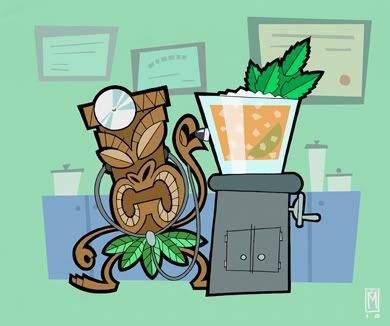
Plus, I made a drawing of a tiki doctor giving a Mai Tai a physical exam. That has to count for something at least.


First, a quick gander at what is generally considered the authentic, original recipe from 1944:

2 oz. Wray & nephew 17-year-old Jamaican rum
.5 oz. French Garnier Orgeat
.5 oz. Holland DeKuyper orange Curacao
.25 oz. Rock Candy Syrup
Juice from one fresh lime

Shake everything with ice and strain into a double old-fashioned glass full of crushed ice. Garnish with half the spent lime shell inside the drink and a sprig of fresh mint at the edge of the glass.


Looks fairly simple, right? There's just a few problems:

1) Wray & Nephew 17-year old rum hasn't existed for decades.

2) To the best of anyone's knowledge, Garnier orgeat can no longer be found either.

3) The current formulation of DeKuyper's orange Curacao is almost certainly not the same as it was back in '44.

4) What the hell is Rock Candy Syrup?

5) And while we're at it, what the hell is orgeat? And Curacao?

6) How much juice can I get from a lime?


If we want to make at least a somewhat legitimate attempt to approximate what this recipe tasted like, we have to make some concessions. Remember, the ability to compromise is a virtue, so let's keep the common good (making a tasty drink) in mind and soldier on.

Now here you may be thinking, "But wait...on vacation last Summer I had a Mai Tai at 'Benny's Beachfront Bazooka Bar' in Panama City, and it had pineapple juice and orange juice and red stuff and came in a hollowed-out cantaloupe with a live tree frog impaled on a sparkler as a garnish. This recipe leaves a bunch of stuff out!"

The short answer is no, it doesn't. For the sad tale of how the original Mai Tai was bastardized into oblivion almost from the moment of conception, consult the sources listed above. For now, back to the drink...

Like I mentioned above, concessions have to be made even if we're trying to re-create this drink as faithfully as possible. To that end, there are a number of modified recipes that do a good job of approximating the original, but since it's impossible to know exactly what it tasted like from top to bottom, we have to make some allowances. Lighten up- it's only a drink after all.

After extensive trial-and-error with more recipes than I can remember, this is the one I happen to like best:

1 oz. Appleton V/X rum
1 oz. St. James Royal Ambre rum
.5 oz. Marie Brizard orange Curacao
.5 oz. Orgeat
.75 oz. Fresh lime juice

Shake everything with ice and strain into a double old-fashioned glass full of crushed ice. Garnish with half the spent lime shell inside the drink and a sprig of fresh mint at the edge of the glass.

So let's break this sucker down...

RUM: The Mai Tai is a rum-based drink, and hardcore rum geeks did us a great service awhile back by suggesting that mixing equal parts aged Jamaican rum (the Appleton) and Martinique rum (the St. James) approximates the character and flavor of the long-gone 17-year old Wray & Nephew called for in the original. And for that we thank them. When you pair the right rums, the combination absolutely sings, and is the foundation of a worthwhile Mai Tai. In fact, the "One Jamaican, one Martinique" rule of thumb has proven so fun to follow, that it has compelled more than one Mai Tai enthusiast to tinker endlessly with 2-part rum combos in search of the "perfect" Mai Tai...which is really just the one you happen to like best. Follow their example and experiment on your own. There's a lot of rum out there, so don't be bashful.

ORANGE CURACAO: Orange Curacao is a liqueur usually made with bitter orange peel as the main flavor component, but formulas vary from brand to brand, some adding or substituting a variety of other ingredients and using different alcohols as a base. All you really need to know for making a good Mai Tai is to avoid the cheap stuff. How do you know what brands to steer clear of? A good place to start would be to check out the valiant efforts of this guy who has compiled more orange liqueur reviews than anyone I know of. I happen to prefer Marie Brizard for my Mai Tais, but as I said above, experiment until you find one you like!

(Oh, and in a pinch the blue stuff is fine, except that your Mai Tai will end up green.)


ORGEAT: Orgeat is a syrup flavored primarily with almonds and a small amount of orange flower water. Sometimes rose water is also added, but it's not crucial to the flavor. Orgeat is key in making a decent Mai Tai, and using a substandard one will sink an otherwise good drink. The general consensus is that making your own is ideal- It's nowhere near as difficult as it might sound, and I've found this recipe is simple and yields a wonderful-tasting syrup that is superior to any commercial product I've tried. However, if you don't feel like fiddling with all that, there's a person who can provide you with some that is the next best thing to homemade.

(Full disclosure: The labels for Trader Tiki syrups feature my dopey artwork, but don't let that influence your buying decision- The stuff on the inside of the bottle is top-notch.)

Also, people ask me all the time how to pronounce "orgeat", and since no two people I've ever asked say it the same way, I'm as stumped as they are. I've found that pronouncing it "almond syrup" usually gets the job done.

ROCK CANDY SYRUP: This is essentially simple syrup (sugar and water heated until the sugar dissolves). "Rock Candy Syrup" is the name Trader Vic's sells it under, but you can make your own simple syrup easily by combining sugar and water in varying ratios (1:1, 2:1, and so on). I use Demerara sugar because of the depth of flavor it adds, but since the Mai Tai recipe I like omits the .25 oz. simple syrup, I save it for other drinks. But if your Mai Tai needs a little sweetening, fire away!

LIME JUICE: It's been said a thousand times already, but bears repeating: Use fresh lime juice. That means buying fresh limes, cutting 'em open and squeezing out the juice by whatever means you prefer. And since limes can vary widely in size and juice content, I've found that .75 oz. is a nice amount regardless of how stingy or forthcoming your limes may be. Just remember- the little blast of citrus acidity and tartness the lime juice provides is another key component in a Mai Tai, so always use fresh-squeezed. Or the ghost of Vic Bergeron will angrily take up residence in your liquor cabinet and mock you viciously.

GLASS: The Mai Tai is served in a double old-fashioned glass. Why? Because Vic said so, that's why. Aside from that, a double-old-fashioned glass holds the liquid, a pile of crushed ice, a half a lime shell and a mint sprig perfectly. I admit to using a variety of tiki mugs for my Mai Tais from time to time, but that's no crime given their thematic harmony with the beverage in question. Remember: learn the rules before you break them.

ICE: Get hard, clean ice cubes and crush 'em. Put them in a hand-cranked crusher, wrap them in a towel and whack it with a rolling pin, throw them in the blender, use a Lewis bag and mallet, whatever...just pick a method that works for you and crush that ice. Then dump it in your glass where it will await the rich, amber embrace of your about-to-be-poured Mai Tai. Just make sure to leave a few cubes unmolested for shaking.

GARNISH: Hopefully you didn't immediately whisk one of your lime halves into the trash after juicing. If so, pull it out of the trash and place it into your drink. Just kidding. Take your clean, freshly-juiced half-shell and gently push it into the drink so it nestles regally amongst the sparkling ice and alluring liquid. Then get a healthy, robust sprig of mint and slap it a few times in the palm of your hand to release the minty essence. Slide it into the drink and admire your handiwork.

Lots of people like to use the Mai Tai as a blank canvas for their inner Bob Ross. This is fine, and given that the Mai Tai is a tiki drink, flowers, powdered sugar, orange peel sculptures and other ephemera aren't beyond the pale. I'd never deter you from using all the happy little trees you like, but I have an affinity for the minimalism inherent in a simple lime shell and mint sprig.

A quick note about straws- some people like 'em, some don't. Not using a straw gets the mint right up in your face and adds the aromatic component of the garnish. Conversely, using a straw keeps your moustache out of the drink. Your call.

Assuming you've followed at least some of the suggestions above and assembled your Mai Tai with care and diligence, you've got a bulletproof cocktail. Enjoy it with friends or just shovel down a few while watching Magnum P.I. reruns. It works either way.


And for those of you who need more Mai Tai mojo, here's a few other places online that have devoted considerable time & energy to examining this fine drink...

SLOSHED!

The Pegu Blog

The Pegu Blog strikes again!

Looka!

Kaiser Penguin

Chip & Andy's Universe

Cask Strength

Cincinnati Cocktails